Looking for bronze casting services you can trust with an original that matters? Bronzecraft is an independent foundry in Attleborough, Norfolk, led by master craftsman Timothy Hannam, with more than three decades of experience in lost-wax casting, sand casting, patination and restoration. Choose full casting or cast-only from your own wax, then use our quotation checklist to start a clear, informed conversation.
Your sculpture took months, sometimes years, to resolve. Turning it into bronze should be a conversation with the person who will actually handle it, not a transaction with a faceless supplier.
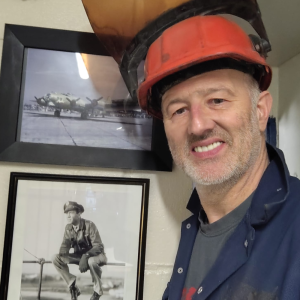
Bronzecraft is an independent bronze foundry in Attleborough, Norfolk. Our bronze casting services are led by master craftsman Timothy Hannam, who has spent more than three decades casting for artists, commercial clients and institutions. We cast using traditional lost-wax and sand casting methods, and we can work from your original or from a wax you have already prepared.
Most foundry websites say they offer “full production” and leave you to work out what that means. Here is how we separate it, so you can see where your project fits before you pick up the phone.
Service
Best for
What you bring
What Bronzecraft does
Full bronze casting
Artists with an original in clay, plaster, resin or another suitable material, and no wish to manage the production chain
Your original and your intentions for the finished piece
Agrees the route with you, prepares the piece for casting, casts it in bronze, finishes it and applies the patina
Cast-only from your wax
Sculptors, studios and fabricators who already make their own waxes, or who have a wax produced elsewhere
A finished, suitable wax, ready to be gated and cast
Casts your wax in bronze and returns it as a raw casting, or takes it on through finishing and patination
Patination and finishing
Existing castings, or new work where the surface is the final artistic decision
The piece, plus a brief or reference for the finish you want
Develops and applies the patina, then agrees the result with you
Restoration and conservation
Historic or damaged bronzes held by galleries, trusts, collectors and artists
The work, its history and any condition reports
Assesses, advises and carries out sympathetic repair and surface conservation
Not sure which route you need? That is a normal place to start. Describe what you have and Tim will tell you honestly which option makes sense, including when a different route would serve you better.
Gita Von Wagner
Steve Cunningham
Vanessa Pooley
David Wadsworth
Nina Fowler
Christopher Marvell
Ready to talk about your project?
Call us via Whatsapp, or tell Tim about your sculpture using the enquiry form. You do not need technical terms or a finished brief. Rough dimensions and a few photographs are enough to begin.
A bronze casting should look like your work, not like a version of it. The details that matter most are usually the ones that are easiest to lose: a thumbprint in the clay, the grain of a tool mark, the way a surface catches the light.
Tim handles the casting relationship personally. That means one named craftsman who understands why a particular texture is there, and who will tell you early if something in the original will not survive the process as it stands. You get a decision-maker who has done this for over twenty years, not a handover between departments.
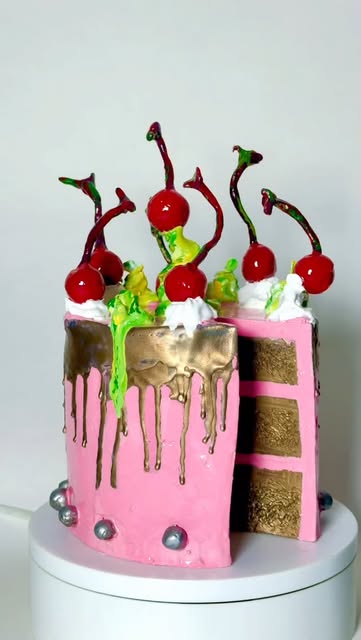
Bronze cast for "The Cherry Cake" by Alex J Wood
Alex J Wood sent a wax. Bronzecraft cast it in bronze, then returned it back to him for finishing with hand painted enamels.
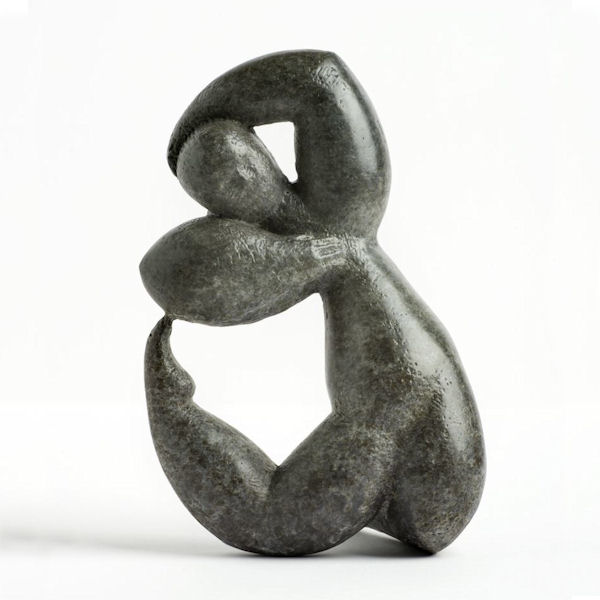
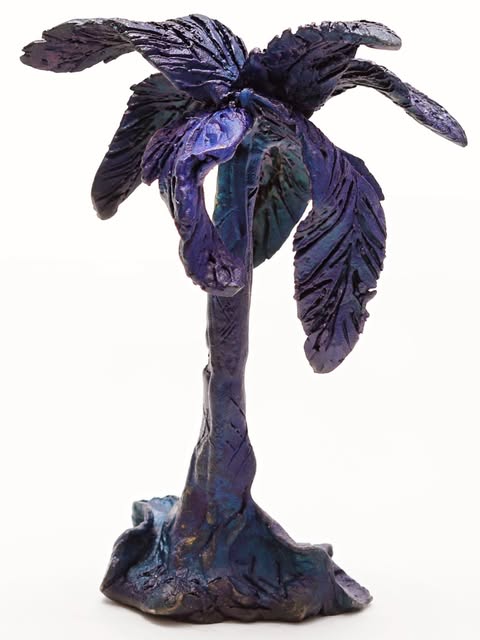
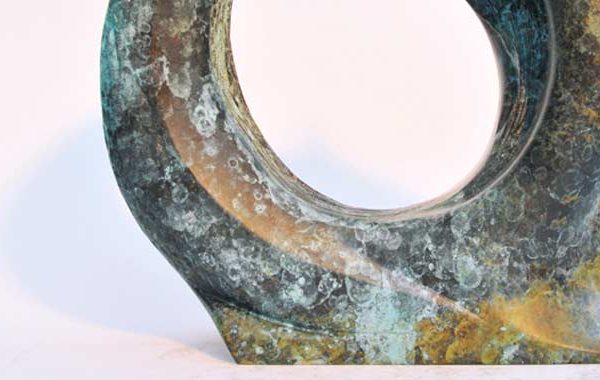
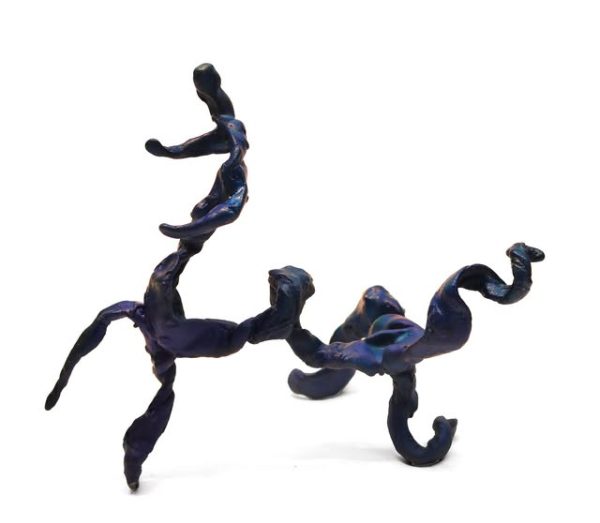
Twilight Palms bronze
Twilight Palms bronze with iridescent purple patina (2025)
How your sculpture becomes bronze
The lost-wax process is more than two thousand years old, and it is still the best way to capture fine detail in bronze. Generally speaking, your commission moves through these stages:
Enquiry and review. You send photographs, dimensions and your intentions. Tim reviews the piece and replies with questions and a recommended route.
Preparation of the original. Where needed, a mould is taken and a wax reproduction produced. If you supply your own wax, we inspect it and confirm it is ready to cast.
Gating and investment. The wax is fitted with a system of channels through which metal will flow and gases will escape, then encased in a heat-resistant investment material.
Burn-out and pour. The wax is melted out, leaving a precise cavity, and molten bronze is poured into it. This is the “lost” in lost wax.
Divesting and chasing. The investment is removed and the casting is cleaned. Channels are cut away, joins are resolved and the surface is worked back to match your original.
Patination and approval. Colour is developed on the surface chemically and by hand, then agreed with you before the work is finished and sealed.
Sand casting is a different, well-established route that suits certain forms and scales. If it is appropriate for your piece, we will explain why, and what trade-offs it carries compared with lost wax.
Who we cast for
Artists and fine art commercial clients
You want your work reproduced faithfully, with a foundry that treats your decisions as final. We offer collaborative, bespoke casting for one-offs and, where appropriate, small editions.
Galleries, museums and trusts
Restoration, new commissions and expert advice on historically significant bronzes call for care and a documented approach. We work with the sensitivity that irreplaceable work demands.
Designers and fabrication professionals
If you need bespoke metal components or prototypes with intricate detail, traditional casting combined with 3D printed patterns can offer a route that standard fabrication cannot.
Where traditional casting meets 3D printing
Some forms are difficult or uneconomic to make by hand. Complex internal structures, intricate repeating details and prototypes that need to be tested before committing to bronze are all examples. Where it suits the project, Bronzecraft can bring digital modelling and 3D printing into the process, so that a traditional lost-wax casting is produced from a more precisely made pattern.
It is a way of extending what a sculptor or designer can realistically cast, with the metal, the finish and the craft still entirely traditional.
What to send for a bronze casting quotation
The most common reason a quote takes longer than it should is missing information. You do not need all of this, and “I don’t know” is a perfectly good answer. The more you can include, the more precise our first reply will be.
Photographs. Four or more, taken in good light from the front, back, both sides and close-ups of any fine detail or texture.
Overall dimensions. Height, width and depth of the original, and the size you want the bronze to be if that is different.
What the original is made from. Clay (wet, dried or fired), plaster, resin, wax, wood, found objects or something else.
Whether you already have a wax. If so, tell us who made it and how it was produced, so we can judge if it is cast-ready.
How many casts you want. One-off, a small edition, or an open question you would like advice on.
The finish you have in mind. Raw bronze, a particular patina colour, a polished surface, or a reference image.
Where the finished work will live. Indoors, outdoors, in a public setting or a private collection. This affects patination and sealing decisions.
Your deadline. An exhibition, an unveiling, a fair or a commission date. Tell us early so we can be honest about what is realistic.
Anything it will be mounted on. Base, plinth, fixings or armature, and who is making them.
Get in touch
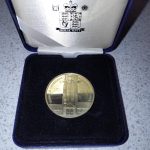
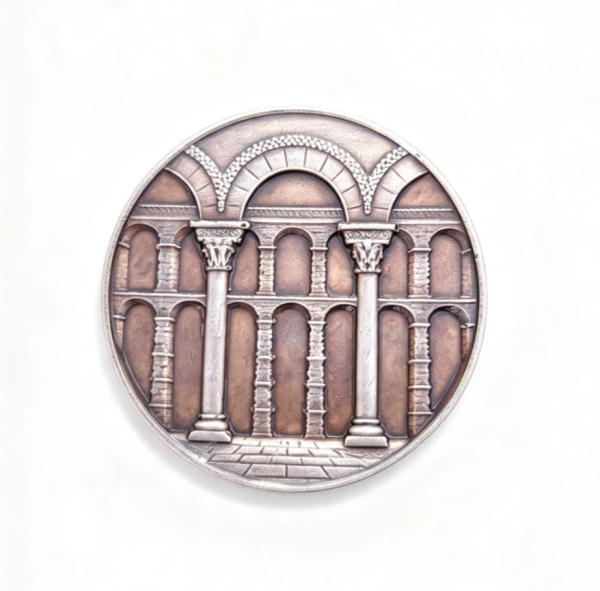
World Monuments Foundation (WMF) Award Cast in Silicon Bronze
130mm WMF Award created at Bronzecraft
What shapes the cost of bronze casting
Bronze casting is a skilled, labour-intensive process, so there is no meaningful single price per kilogram. We would rather explain what moves the figure than give you a number that does not fit your piece. The main factors are:
Size and weight. More metal means more material and heavier handling, and it may call for the piece to be cast hollow in sections.
Complexity. Undercuts, thin or projecting elements and very fine detail all add preparation and finishing time.
The state of the original. A cast-ready wax is quicker to take on than an original that needs a mould and wax reproduction made first.
Number of casts. Editions can spread some of the preparation across the run, which changes the cost per piece.
Finish. A simple patina and a layered, hand-developed surface are different amounts of work.
Extras. Mounting, bases, transport and installation.
Tim will give you a quotation based on your actual piece and explain what it includes.
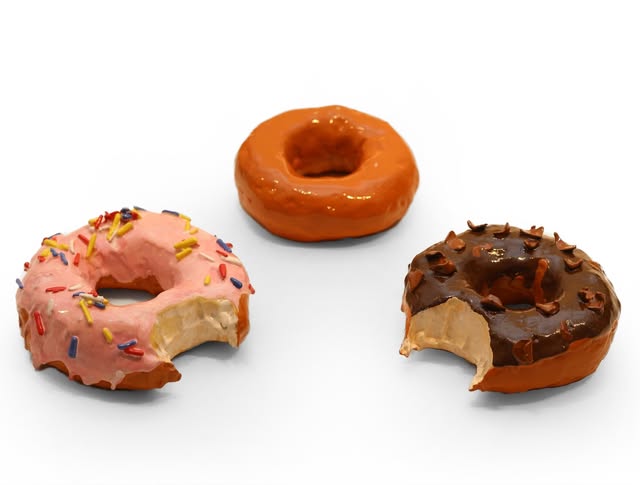
The Donuts were cast in bronze for Alex J Wood
The Donuts, by Alex J Wood were cast in bronze, then finished using enamels. The Chocolate Donut was auctioned for charity at Christie's for the Terrence Higgins Trust.
Is your piece ready to cast? Five things we look for
A good foundry tells you about problems before they become expensive. These are the issues we check first, and the ones worth thinking about before you send your work:
Thin or unsupported elements. Slender limbs, feathers, fingers and projecting details can be fragile in wax and in the finished metal. Tell us which parts matter most to you.
Deep undercuts. Forms that curl back on themselves may need multi-part moulds, which affects the route and the budget.
Drying or cracking clay. If your original is clay, tell us its current state. Cracks, shrinkage and fired or unfired condition all change the approach.
Weight and wall thickness. A very solid form is heavy and expensive in bronze. A well-judged hollow casting often keeps the look while sensibly managing the metal.
Fixings and joins. If your sculpture will be mounted, bolted or assembled from several castings, plan the fixing points before casting, not after.
None of these should stop you getting in touch. They are simply the questions that Tim will ask first.
Tell Tim about your sculpture
The first step is simple: tell us what you have.
You can call or send a message. There is no obligation, and no technical vocabulary required.
Choosing a foundry is a long-term decision. Whoever you work with, these questions will tell you how they work:
Who will personally handle my piece from start to finish?
Which stages are done in your own workshop, and which are done by partners?
What happens to my original, and will it be returned undamaged?
Who owns and stores any moulds that are made, and what happens if I want further casts?
Which alloy will you use, and why is it right for where the piece will live?
What finishes and patinas can you show me on real completed work?
At what points do I see and approve the work?
What do you need from me, and what will you tell me if my piece has problems?
How do you handle deadlines and what happens if the schedule slips?
Can I speak to the person doing the work before I commit?
We are happy to answer all ten before you commit to anything.
Get in touch
What happens after you get in touch
We would rather you knew exactly what to expect:
Tim reads your message and looks at your photographs. He may reply with a few follow-up questions.
You agree a route. Full casting, cast-only, or an alternative, with the reasoning explained in plain language.
You receive a written quotation setting out what is included and what is not.
We agree a schedule that fits your deadline as closely as the work allows.
Work begins, with you involved at the approval points that matter, particularly the patina.
Patination and restoration
The surface is where a bronze becomes finished work. We develop patinas from subtle, natural browns to richer greens and blues, and we agree the result with you rather than leaving it to chance. For existing bronzes, our restoration and conservation work covers assessment, repair and sympathetic surface treatment, with the aim of preserving the character of the original rather than erasing its age.
A well-made, well-finished bronze can outlast the people who commission it by centuries, and bronze is a metal that can be recycled at the end of its life, which makes it a sensible material for work that is meant to endure.
Questions about bronze casting services
Yes. Many of our clients are first-time commissioners. Send us photographs and a few details, and we will guide you through the options without assuming any technical knowledge.
Yes. Our cast-only service is designed for exactly this. We will check the wax is suitable, and tell you honestly if anything needs attention before casting.
It depends on size, complexity, the state of your original, and our current workload. We will give you a realistic schedule when we quote, and the earlier you tell us about a deadline, the better we can plan around it.
Costs depend on the size, complexity and finish of your piece and the number of casts you want. See the section above for what shapes the figure, then send us your details for a quotation based on your actual work.
Where a piece is suitable, yes. Talk to us early about how many casts you want, how the original and any moulds will be handled and stored, and how the edition will be numbered.
Handling and returning your original is part of the conversation from the start. Some processes can alter or consume an original, and we will explain this before anything is agreed.
Yes. We carry out restoration, conservation and new commissions for galleries, museums and trusts, and we can provide advice on the care of historic bronzes.
Ready to talk about your project?
Call us via Whatsapp, or tell Tim about your sculpture using the enquiry form. You do not need technical terms or a finished brief. Rough dimensions and a few photographs are enough to begin.