
 Introduction
In the quiet lanes of Cambridgeshire and the rolling farmland of Norfolk, a remarkable creative partnership has shaped some of Britain’s finest contemporary bronze sculpture. At its heart stands Christopher Marvell—Cambridge-based sculptor, whose spare, evocative works inhabit the boundary between modern abstraction and timeless figurative form. For more than two decades, his vision has been brought to life through Bronzecraft Ltd, the independent fine-art foundry in Attleborough, Norfolk, led by master founder Timothy Hannam.
What makes this collaboration even more distinctive is the depth of training behind the foundry’s craft: Timothy Hannam received private tuition from Martin Walsh, then Head of 3D Sculpture at Norwich School of Art (now Norwich University of the Arts), grounding his technical skill in the same rigorous artistic tradition that shaped East Anglia’s sculptural legacy .
This article explores Marvell’s artistic journey, his deep connection to the Cambridge landscape, and how his long partnership with Bronzecraft—built on formal training, shared values, and local roots—preserves and advances the ancient craft of lost-wax casting.
Who Is Christopher Marvell?
Born in 1964 in Clacton-on-Sea, Christopher Marvell studied sculpture at Newcastle University (1982–1986), absorbing the legacy of Victor Pasmore and Richard Hamilton, and developing a rigorous approach to form and process. Soon after graduating, he settled in Cambridge, establishing his first studio at Fulbourn Manor, where he built a practice rooted in observation, patience, and respect for material.
Artistic Vision
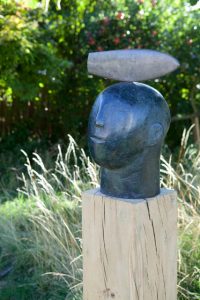
Marvell describes his work as “emblematic rather than literal”. Whether carving figures, birds, or animals, he distils essence rather than replicating detail. “None of my sculptures represent anyone or anything specific,” he says. “They are just a head, just an owl, just a dog—forms that carry emotion and archetype”. Influenced by Henry Moore, Marino Marini, and the quiet lyricism of Vaughan Williams or Britten, his work feels deeply English: rooted in landscape, yet universal in its quiet power.
From early maquettes to monumental commissions, every piece begins with drawings and small clay models, evolving through plaster moulds to the final bronze—each stage requiring precision and craft. His public works include The First Undergraduate (Fitzwilliam College, Cambridge), Rosie Robinson (Addenbrooke’s Hospital), and Rider, Tall Penwith Bird, and Big Starry Owl, held in collections across Europe and the US.
The Bronze Medium: Why It Matters
For Marvell, bronze is more than a material—it is a language. “It is slow, expensive, repetitive, and demanding,” he admits, “but the surface quality, depth of patina, and ability to hold fine detail are unmatched”. Bronze ages with dignity; it deepens, changes, and responds to its environment, making it ideal for outdoor public art and indoor collections alike.
The journey from plaster to metal is not straightforward. Traditional lost-wax casting—the method used by both Marvell and Bronzecraft—dates back 5,000 years, yet remains the gold standard for fine art. It requires technical mastery, artistic sensitivity, and a shared understanding between artist and founder.
Bronzecraft Ltd: Norfolk’s Independent Fine Art Foundry
Based in Attleborough, Breckland, Bronzecraft Ltd was founded and is run by Timothy Hannam, a time-served founder and master metal polisher with over 30 years of experience . What began as a specialist finishing service has grown into Norfolk’s only foundry dedicated to the ceramic shell lost-wax process—a cleaner, more precise alternative to traditional solid-mould casting.
Training & Artistic Foundation
Crucially, Timothy Hannam’s expertise is not just practical—it is artistically informed. Early in his career, he received private tuition from Martin Walsh, then Head of 3D Sculpture at Norwich School of Art. Walsh was a leading figure in the region’s arts education, known for bridging fine-art practice and technical making . This mentorship gave Hannam a rare advantage: he understands not only how to cast bronze, but why form, proportion, and surface matter to the sculptor. It means he approaches every piece as a work of art, not just a metal component.
Key Strengths
- Ceramic shell technology: Faster de-waxing, finer detail retention, fewer defects
- Patination expertise: Custom chemical finishes to create rich, stable tones
- Traditional + modern: Combines Walsh’s academic rigour with 3D printing and digital scaling
- Restoration & conservation: Works with museums and trusts to preserve historic bronzes
A Partnership Built on Trust & Shared Language
The connection began in the early 2000s, when Marvell sought a foundry that could match his exacting standards. Many larger facilities treat art as volume; Bronzecraft offered dialogue, hands-on care, and—thanks to Hannam’s training—an intuitive grasp of sculptural intent.
How They Work Together
- Concept & Maquette: Marvell refines form in clay until it feels “right”.
- Plaster Master: The definitive model, signed and dated.
- Wax & Shell: Bronzecraft creates wax copies, builds ceramic shells, and fires to remove wax.
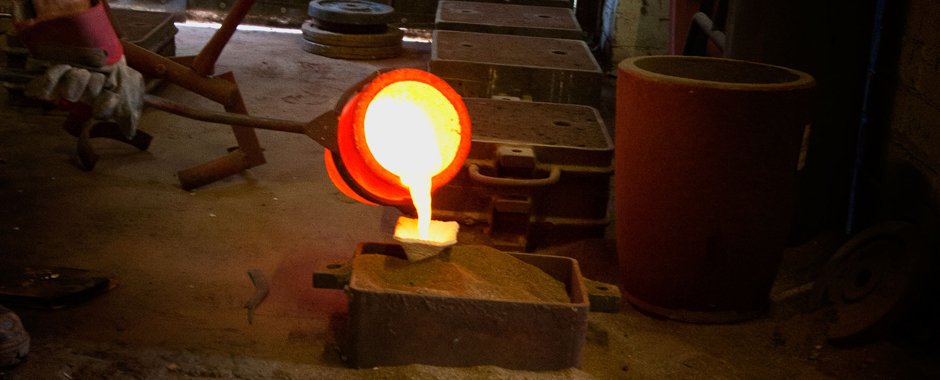
- Pour & Cool: Molten bronze poured at 1,100°C; cooled slowly to avoid stress.
- Chase & Finish: Hannam’s trained eye smooths seams and preserves the artist’s surface.
- Patination & Sign-off: Marvell works directly with Hannam to select the final finish.
Why This Partnership Works
- Shared artistic vocabulary: Hannam learned sculpture’s principles from Martin Walsh; Marvell studied under leading modernists—they speak the same language.
- Proximity: Cambridge to Norfolk is 90 minutes, allowing constant checks.
- Consistency: Over 20 years, they have refined a shared understanding of flow, weight, and texture.
- Heritage continuity: Links Norwich’s art school tradition, Norfolk’s metalworking past, and Cambridge’s contemporary sculpture.
Notable Works Cast at Bronzecraft
- The First Undergraduate: Fitzwilliam College, Cambridge—warm patina, smooth planes, exemplary finish.
- Tall Penwith Bird: Slender, elongated form showcasing fine detail retention.
- Rider: Balanced composition where patina shifts naturally across the surface.
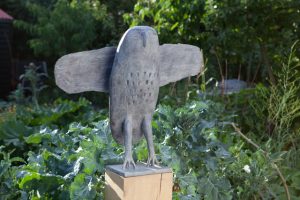
- Big Starry Owl: Volume and softness held in perfect balance—only possible with skilled casting.
Bronze Heritage in East Anglia
From medieval church brasses to 20th-century foundries, East Anglia has always valued bronze. Marvell and Bronzecraft carry this forward:
- Preserving skills: Hannam’s training from Martin Walsh ensures sculptural understanding remains in the foundry.
- Sustainability: Bronze is fully recyclable; ceramic shell uses less energy.
- Local legacy: Adding to Cambridge’s public art alongside Moore, Hepworth, and Ayrton.
Perspectives
Christopher Marvell:
“Timothy doesn’t just cast metal—he understands the form. That comes from his training with Martin Walsh; he sees what I see. Without that shared sense, a piece can lose its soul. Bronzecraft gives it back.”
Timothy Hannam:
“Martin Walsh taught me never to separate craft from art. When Christopher brings a model, I’m not just pouring bronze—I’m translating his vision into something permanent. That’s the lesson I carry every day.”
Conclusion
Christopher Marvell stands as one of Cambridge’s most distinctive sculptors: rooted in place, respectful of tradition, yet entirely contemporary. His partnership with Bronzecraft is elevated by the rare artistic education Timothy Hannam received from Martin Walsh—proof that technical skill is only as good as the understanding behind it.
Together they show that in a digital age, slow, thoughtful craft still creates work that will stand for centuries.