
TL;DR Bronze casting covers several distinct methods such as lost-wax, sand and hollow casting. This guide summarises which approaches suit different projects, walks through the main production stages, highlights common pitfalls and points you to further reading and resources for commissioning or technical work.
Bronze casting remains a versatile route to durable, finely detailed metal work. Whether you are an artist preparing a commission, a designer prototyping a part, or an engineer weighing options, this guide explains the principal techniques and the practical choices that affect cost, finish and lead time.
Why bronze casting still matters
Bronze offers a combination of strength, surface quality and longevity that suits sculpture, architectural fittings and functional components. Its ability to capture fine detail makes it valuable where form and finish matter. For many makers, the choice of casting method determines the degree of detail, the wall thickness that can be achieved and the post-cast finishing required.
This section sets the scene for method comparison and process breakdown that follow.
A short answer for different needs
For high-detail small to medium sculptures, lost-wax casting is typically the best choice because it reproduces fine modelling and complex undercuts. For simple shapes, heavy castings or when lower-cost tooling is important, sand casting may be preferable. Hollow casting techniques are used when weight, material saving and thinner walls are required. The choice depends on scale, detail, production run and budget.
Read on to see how each method works and what to expect at every stage.
Core bronze casting methods
Different methods suit different briefs. Below are the most commonly used approaches with a short explanation of when each is appropriate.
Lost-wax (investment) casting
Lost-wax casting begins with a detailed model, usually in wax, that is used to form a ceramic or investment mould. It is well suited to sculpture and complex shapes where surface detail matters. The process supports relatively small batches or single commissions with a high level of finish.
Sand casting
Sand casting uses a sand mould formed around a pattern. It is often used for larger or simpler components and for work where the surface finish can be machined or cleaned afterwards. Sand moulds can be quicker and less costly for larger volumes or heavy sections.
Hollow casting and other variants
Hollow or shell techniques combine pattern-making and controlled gating to produce thin-walled castings that reduce weight and material use. These are common in large sculptural work, where a solid pour would be impractical, and where a controlled wall thickness is required.
Each method leads naturally into the standard process stages described below.
Key stages in a typical bronze casting process
Although steps vary by method, a typical workflow contains a few core stages. Understanding each stage helps with planning, cost estimation and scheduling.
1. Model or pattern preparation
This stage includes sculpting the original in clay or creating a CAD model and producing a physical pattern. For lost-wax work the model is taken into wax; for sand casting a pattern in wood or resin is used. Good preparation here reduces revisions and post-cast work.
2. Moulding and core-making
The chosen mould type is prepared: ceramic investment for lost-wax, packed sand for sand casting, or shell moulds for hollow work. Cores may be required to form internal cavities or to control wall thickness.
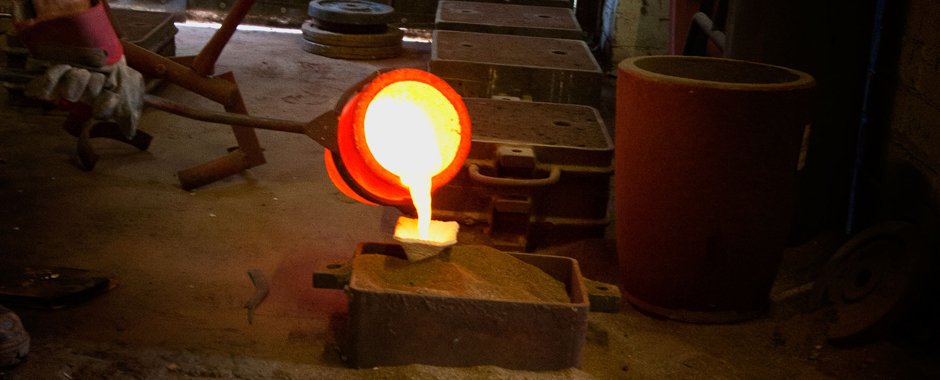
3. Burnout and metal pouring
In lost-wax the wax is removed by burnout leaving a ceramic cavity. The bronze alloy is melted to the appropriate temperature and poured. Foundry practice at this stage influences soundness and porosity of the cast piece.
4. Cleaning, chasing and assembly
After the metal has cooled, gates and risers are removed, surfaces are cleaned and seams are chased to restore intended details. If the work is in sections, pieces are joined at this point.
5. Patination and finish
Patination and surface finishing complete the appearance. This can be mechanical polishing, chemical patination or applied coatings for protection. The chosen finish affects maintenance and long-term ageing.
Materials and tooling to consider
Choice of alloy, wax type, mould materials and core mixes all affect outcome. Standard bronze alloys vary in appearance and casting behaviour; some are more fluid and better at filling thin sections. Wax selection matters for detail and for how easily the wax is removed during burnout.
Tooling and fixture considerations include gating design to ensure adequate metal feed, venting to avoid trapped gases and suitable cores where hollow sections are required. Early collaboration with a foundry helps avoid costly redesign later.
Common issues and how to avoid them
Several predictable problems appear across methods. Planning and experienced foundry practice reduce these risks:
- Porosity and shrinkage: design risers and feeders appropriately and control cooling rates.
- Incomplete fills: ensure gating and venting are sized for the alloy and section thickness.
- Surface defects: review mould surface quality and avoid contaminants in the wax or pattern.
- Distortion: support thin sections during cooling and control handling at each stage.
Anticipating these issues during the design and pattern stages simplifies later corrective work.
How to choose a method for your project
Match the method to the priorities of detail, scale, budget and repeatability. For single, highly detailed sculptures, the precision of lost-wax casting usually justifies the cost. For larger or simpler forms where tooling costs must be reduced, sand casting may be the sensible choice. If weight and wall thickness matter, investigate hollow casting options.
When commissioning, provide clear references for finish, acceptable tolerance and intended location. Early discussions with a foundry clarify feasibility and timeline.
FAQ
Lead time depends on scale, method and the foundry’s schedule. Simple prototypes or small sculptures can often be completed within a few weeks, but larger or multi-part commissions typically require several months from model to finished patination.
Lost-wax casting generally reproduces finer surface detail and complex undercuts. Sand casting is effective for simpler or larger sections where the surface can be finished after casting.
Size is primarily limited by the foundry’s equipment and the chosen method. Very large sculptures are commonly cast in sections and assembled to achieve the final scale.
Maintenance depends on the finish and exposure conditions. Outdoor work may need periodic inspection and conservation-grade treatments, while indoor pieces usually require less frequent care.
Artists should deliver stable models and clear notes on finish and surface intent. Early consultation with the foundry helps translate artistic detail into a castable pattern and identifies any necessary changes for moulding or gating.
Yes. 3D printing is routinely used to produce patterns or masters that are then invested or used to make moulds for traditional casting methods, enabling complex geometries that would be difficult by hand.
Summary and what to do next
Choose the method that aligns with the priorities of detail, scale and budget. For artists and commissioners, begin with a short briefing that states the desired finish, the installation environment and any size constraints. For technical projects, provide CAD files and discuss gating, cores and tolerances with the foundry early.
If you need help assessing which method is right for a commission or prototype, Bronzecraft’s foundry in Attleborough works with both artists and fabrication professionals and can advise on feasibility and likely timelines. See the related guides above for deeper technical articles and method comparisons.