
Lost‑wax casting is one of the oldest methods for creating fine bronze sculpture, memorials and decorative metalwork — used for over 5,000 years from ancient Greece to modern foundries. Yet the way we make the mould itself has changed dramatically, with profound effects on quality, speed, cost and the environment.
For centuries, the standard approach was solid block plaster investment: encasing the wax pattern in a thick, dense block of plaster‑based material, then firing it to remove the wax and harden the mould. Today, specialist art foundries — including Bronzecraft Limited — use ceramic shell investment almost exclusively. This shift is not just about working faster or producing better detail; it also brings significant environmental benefits that are increasingly important for responsible manufacturing.
This article compares the two methods, explains why ceramic shell is the more sustainable choice, and outlines why we have never looked back.
How Each Method Works
To understand the differences, it helps to see how each mould is built and processed.
Solid Block Plaster Investment
The wax pattern is placed inside a frame or flask, and a thick slurry of plaster, silica and water is poured over it. This sets into a single solid block — often many centimetres thick — completely surrounding the pattern. Once set, the whole block must be heated slowly and steadily to melt out the wax, cure the binder and harden the mould.
Because the block is so dense and holds heat poorly, it takes literally days of continuous firing to complete the process. Even after firing, the mould remains brittle and heavy, and is usually broken away completely after casting.
Ceramic Shell Investment
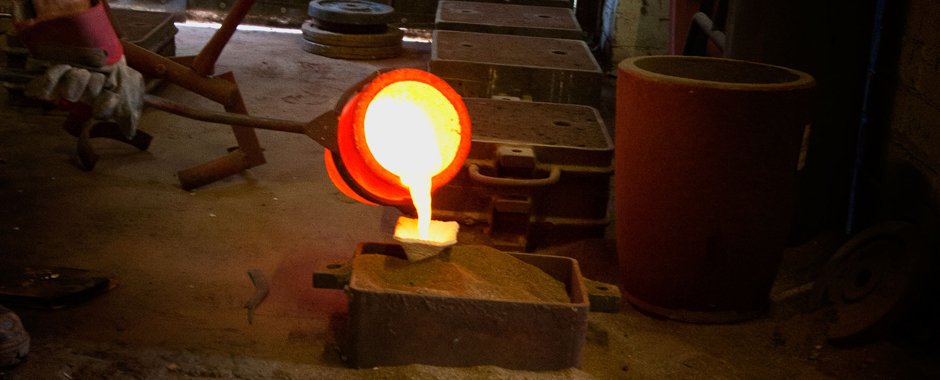
Instead of one thick block, the wax pattern is built up in multiple thin layers. Each layer is a slurry of fine refractory ceramic grains and a silica binder, followed by a coarser backing layer for strength. Between coats, the shell dries in controlled conditions.
Over several hours, this creates a hollow, rigid shell — just a few millimetres thick — that perfectly replicates every surface detail of the wax. When ready, the shell goes into the kiln: the entire firing and wax burnout process takes only five minutes before it is ready for casting.
Firing Time and Energy Use: The Biggest Difference
This is where the environmental gap is widest.
Solid block plaster moulds have enormous thermal mass. Heat must penetrate slowly through the entire thickness to avoid cracking or exploding the mould. Typical firing cycles take 48 to 72 hours or longer, running kilns at high temperatures continuously. Most of that energy is wasted heating up the huge volume of inert material in the block — material that contributes nothing to the final casting. The wax itself melts slowly over many hours, and can never escape cleanly or quickly.
Ceramic shell moulds are thin and heat almost instantly. Total firing and wax burnout takes just five minutes — the shell reaches full temperature immediately, wax drains away completely and cleanly, and the mould is ready. There is no long, wasteful soaking or heating‑up period. Very little energy is wasted heating excess material.
For a foundry running many moulds every week, this means massive, dramatic reductions in fuel or electricity consumption, and far lower carbon emissions per piece cast.
Environmental Advantages of Ceramic Shell
Beyond speed and energy efficiency, ceramic shell offers several clear environmental benefits over solid plaster:
- Far Lower Energy Consumption
A five‑minute total firing cycle eliminates days of unnecessary high‑heat running. Ceramic shell uses only a tiny fraction of the energy required for plaster blocks. Less energy used means fewer greenhouse gas emissions and less demand on local power or fuel resources.
- Reduced Waste
Solid plaster blocks are single‑use, and almost the entire mass becomes rubble after casting. Much of this cannot be recycled easily because of contamination from silica, ash and residual metal.
Ceramic shell produces less waste by volume — often 70–80 % less — because only the necessary material is used. Some shell materials can be processed and reused in backing layers, reducing raw material demand.
- Cleaner Wax Recovery
Because the wax drains out cleanly and quickly rather than burning slowly over days, more of the pattern wax is recovered intact and can be reused directly. This cuts waste and reduces the amount of new wax required for future projects.
- Cleaner Raw Materials
Modern ceramic shell formulations avoid many of the additives found in traditional plaster investments, including certain setting agents and excess binders. Firing produces fewer volatile organic compounds (VOCs) and less harmful airborne emissions, creating a safer workshop and lighter environmental footprint.
- Better Resource Efficiency
Thin shells use far less silica, plaster and binder per mould. Over a year, this adds up to many tonnes less raw material extracted, processed and transported — important when all these materials have their own environmental costs.
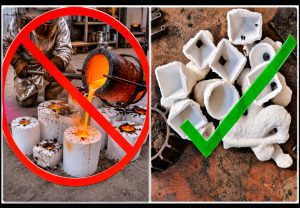
Ceramic Shell vs Solid Block Plaster Investment
Why Solid Plaster Takes So Long — and Costs So Much
The long firing cycle of solid block plaster is not just inconvenient; it is fundamentally wasteful.
- Slow heating is mandatory: If you heat a solid block too fast, trapped moisture turns to steam, expands violently, and can shatter the mould — a dangerous and expensive failure.
- Slow wax removal: Even at full heat, wax takes hours to seep through dense plaster, leaving residue that burns incompletely.
- Long cooling times: Once fired, blocks must also cool slowly before use, adding more days to the process.
- Persistent heat loss: Thick blocks hold heat for hours after firing, making it almost impossible to recover or reuse that energy.
For comparison, ceramic shell moulds complete their firing in minutes and are ready straight away.
Quality and Detail — Not Just Environment
While environmental responsibility is a major reason for the switch, ceramic shell also delivers superior results for art foundry work:
- Sharper detail: Thin layers capture the finest textures, tool marks and delicate features that can blur or disappear in thick plaster.
- Cleaner casting: Fast, complete wax removal leaves no carbon residue to spoil the bronze surface.
- Consistent surface: Uniform wall thickness means even metal flow and fewer defects.
- Stronger yet lighter: Shell moulds resist cracking better during pouring, and are easier to handle safely.
- Better dimensional accuracy: Less shrinkage and distortion keeps the true size and shape of the original wax.
Our Approach at Bronzecraft Limited
At Bronzecraft Limited, based in Attleborough, Norfolk, we have never used solid block plaster investment — every piece we cast uses the ceramic shell lost‑wax method from the start.
We made this choice because:
- It aligns with our commitment to responsible manufacturing and environmental care.
- The five‑minute total firing cycle cuts energy use dramatically.
- It produces the highest possible quality for artists, heritage projects and public commissions.
- It is reliable, consistent and avoids the unnecessary waste of energy and materials.
- It supports our ability to deliver work efficiently without compromising on craft standards.
We know that traditional methods have their place in history, but for fine art bronze casting today, ceramic shell is simply the better, more sustainable choice.
Comparing the Two Methods: Summary Table
Feature Solid Block Plaster Investment Ceramic Shell Investment
Total Firing & Burnout Time 2–3 days minimum
Energy Use Extremely high Up to 95 % lower
Material Waste Very high — whole block discarded Low — minimal material used
Detail Reproduction Good, but can blur fine features Excellent — captures every texture
Mould Strength Brittle, prone to cracking Rigid, resistant to thermal shock
Environmental Impact High emissions, heavy resource use Much lower emissions, cleaner process
Cycle per Mould Several days Minutes
Looking Forward: Sustainable Foundry Practice
The shift away from solid plaster is part of a wider move toward greener metalworking across the UK and beyond. Reducing energy use, cutting waste and choosing cleaner materials does not mean lowering standards — it means modernising how we work so that fine bronze can be produced responsibly, for generations to come.
Ceramic shell is not a perfect solution, and there is always room for improvement — from recycled materials to improved binder systems — but compared to solid block plaster, it represents a huge step forward for both quality and the environment.
Final Thoughts
Choosing how to make a mould matters. It affects not just the price or the lead time, but the carbon footprint of every sculpture, memorial or heritage piece we create.
Solid block plaster served its purpose well for many generations, but its days as the standard for fine art foundry work are behind us. Ceramic shell lost‑wax casting offers near‑instant firing, faster results, finer detail, and a far lighter environmental load — which is why it remains the only choice for us at Bronzecraft Limited.