
Every sculptor invests countless hours perfecting their work before it reaches the foundry for bronze casting. Yet one of the most significant artistic decisions still lies ahead. The choice of bronze patination has the power to transform a beautifully cast sculpture into an exceptional work of art—or, equally, to detract from months or even years of careful modelling through an unsuitable finish.
Many artists think of a bronze sculpture patina simply as colour. In reality, patination is the final stage of the creative process. It enhances form, reveals texture, creates atmosphere and influences how a sculpture is experienced by its audience. A carefully modelled bronze deserves a finish that complements its character rather than overwhelms it.
This is why sculptors should always seek the advice of an experienced art foundry. A professional foundry has produced hundreds, often thousands, of bronze sculptures and understands how different bronze sculpture finishes affect different styles of artwork. That experience can be invaluable.
The golden rule is remarkably simple:
A bronze sculpture should always look better after patination than it did in its natural cast state.
It sounds obvious, but achieving that goal requires knowledge, restraint and experience.
Bronze Patination Is Part of the Sculpture
The finest bronze patination is never an afterthought. It is part of the sculpture itself.
Every bronze possesses its own personality. The subject matter, modelling style, surface texture, intended location and even the way light falls across the sculpture all influence which finish will produce the strongest result.
A highly polished contemporary sculpture requires a different approach from a textured wildlife study. Likewise, a portrait bust destined for an elegant interior often calls for an entirely different bronze sculpture patina than a large public commission that will spend decades outdoors.
The purpose of patination is not simply to change the colour of the bronze.
Its purpose is to enhance everything the sculptor has already created.
A successful patina reveals detail, increases visual depth and draws attention to the finest elements of the modelling. An unsuitable finish can flatten texture, overpower delicate features or simply distract from the sculpture itself.
Why an Experienced Art Foundry Matters
An experienced art foundry develops an instinct that cannot be learned overnight.
Years of producing bronze castings allow foundry craftsmen to understand how different chemicals react with the bronze alloy, how heating affects colour development and how subtle variations during the patination process can dramatically alter the final appearance.
Sometimes the smallest adjustment makes the biggest difference.
This is why discussions about bronze sculpture finishes should never be left until the very end of production. The foundry is not attempting to dictate artistic style; it is helping the sculptor achieve the strongest possible presentation of their work.
The most successful collaborations occur when sculptor and foundry work together, combining artistic vision with technical expertise.
The Wrong Patina Can Spoil a Beautiful Bronze
One of the biggest misconceptions is that more colour automatically creates a more impressive sculpture.
In reality, the opposite is often true.
The finest bronze sculpture patina supports the artwork without demanding attention for itself.
If viewers notice the colour before they appreciate the sculpture, there is every chance the patina has become the dominant feature rather than the artwork.
Patination should never compete with the modelling.
Instead, it should quietly enhance it.
The most successful bronze sculpture finishes are often subtle, using carefully controlled tonal variations and highlights to reveal the quality of the sculptor’s work without overwhelming it.
The Evolution of Bronze Sculpture Finishes
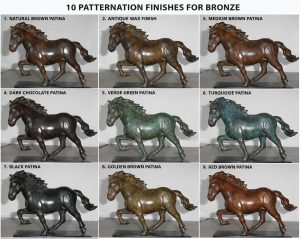
For centuries, the traditional warm brown bronze patina became synonymous with fine sculpture.
There is good reason for that.
A rich brown finish continues to suit many portrait busts, figurative sculptures and classical subjects, allowing the quality of the modelling to remain the focus.
However, artistic tastes continue to evolve.
Today’s sculptors have access to a far broader range of bronze sculpture finishes than ever before.
One of the biggest changes over the past two decades has been the growing popularity of stone-effect finishes.
Granite effects, weathered stone appearances and mineral-inspired patinas have introduced an entirely new dimension to bronze sculpture. These finishes combine the permanence and detail achievable through bronze casting with the visual qualities traditionally associated with carved stone.
Collectors, architects and interior designers increasingly appreciate these contemporary finishes because they allow bronze sculptures to integrate beautifully into modern environments.
Pushing the Boundaries with Colour
Modern bronze patination is no longer limited to traditional browns and greens.
Today’s techniques allow foundries to create remarkably diverse finishes through the careful use of specialist dyes combined with traditional chemicals such as liver of sulphur patina solutions.
When used correctly, these processes can produce deep blues, rich reds, warm yellows and subtle layered effects that were once difficult to achieve consistently.
These colours are not simply applied like paint.
Instead, they become part of a carefully controlled chemical reaction that bonds with the bronze surface itself.
The result is a finish with remarkable richness and depth.
Of course, simply because a colour is possible does not necessarily mean it is appropriate.
Every sculpture demands careful consideration.
An experienced art foundry understands where colour enhances a sculpture and where restraint produces a stronger artistic outcome.
Every Bronze Is Different
There is no universal formula for selecting the perfect bronze sculpture patina.
Every sculpture presents its own challenges.
Scale matters.
Texture matters.
Lighting matters.
Subject matter matters.
Even the location where the finished bronze will be displayed should influence the final decision.
Indoor sculptures often benefit from finishes that respond well to controlled lighting, while outdoor sculptures require bronze sculpture finishes capable of complementing changing natural light throughout the seasons.
This is why professional foundries frequently prepare sample patinas before the final finish is approved.
These samples allow sculptors to make informed decisions based upon the actual appearance of the bronze rather than relying solely upon photographs or assumptions.
Trust Experience
Professional art foundries spend decades refining their bronze patination techniques.
They understand how colours mature, how protective wax coatings influence appearance and how different patinas will continue to develop over many years.
Most importantly, they have experience.
They have seen outstanding sculptures transformed by the perfect finish.
They have also witnessed occasions where an unsuitable colour reduced the impact of an otherwise magnificent bronze.
Listening to that experience is not a compromise.
It is simply recognising that creating exceptional bronze sculpture finishes requires both artistic creativity and technical expertise.
The Final Artistic Decision
Patination should never be regarded as merely the final production stage after bronze casting.
It is the last artistic decision a sculptor makes before presenting their work to the world.
The right bronze sculpture patina enhances detail, creates atmosphere and strengthens the sculptor’s original vision. The wrong finish can distract from exceptional modelling and reduce the impact of an otherwise outstanding work.
Whether choosing a traditional brown finish, a sophisticated granite effect, or exploring contemporary colours created using liver of sulphur patina techniques and specialist dyes, every decision should follow one simple principle.
The bronze must always look better after patination than it did before.
When sculptors combine their artistic vision with the experience of a professional art foundry, the result is far more than a finished bronze.