 Introduction: Completing a Cathedral 1,000 Years in the Making
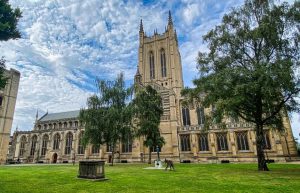
For nearly a millennium, St Edmundsbury Cathedral in Bury St Edmunds stood incomplete—its Gothic silhouette unfinished, a quiet reminder of the grand vision of its medieval founders and Victorian restorers. That changed on 22 July 2005, when the Millennium Tower was officially opened, crowning the cathedral and fulfilling a legacy begun in the 11th century. Standing 150 feet (46 metres) tall, built from 600,000 bricks and faced with Barnack and Clipsham limestone, it was the first major cathedral tower completed in England in over a century.
But beyond stone and brick, the tower’s lasting beauty lies in its metalwork—specifically the bronze components that anchor its design, resist centuries of East Anglian weather, and connect modern craft to ancient tradition. This is where Bronzecraft Ltd, the specialist Norfolk foundry, entered the story. Based in Attleborough, just 22 miles north of Bury St Edmunds, Bronzecraft was chosen to deliver precision bronze casting and finishing for the tower’s critical architectural and decorative elements. Their work was so highly regarded that director Timothy Hannam was formally honoured by the cathedral custodians. This article explores the project, the craftsmanship, and the lasting recognition of this local partnership.
The Millennium Tower Project: Vision, Funding & Design
Background & Timeline
The idea for the tower emerged from the Millennium Commission initiative, which supported heritage and community projects across the UK at the turn of the century. The late architect Stephen Dykes Bower—who had led cathedral restoration since 1943—left £2 million in his will specifically to complete the tower; his associate Hugh Mathew developed the final design, faithful to Gothic Revival principles but engineered for modern durability.
- Start date: 2000
- Completion: July 2005
- Funding: Millennium Commission, Stephen Dykes Bower Trust, public donations, diocesan grants
- Design: Gothic Revival, four-stage tower, fan-vaulted ceiling internally, bell chamber, viewing gallery
The brief was clear: build a tower that looked as if it belonged to the medieval fabric, but used 21st-century materials and techniques to ensure it would last another 1,000 years. This meant sourcing stone, brick, and metal from local suppliers wherever possible—supporting East Anglian craft while reducing transport miles and carbon footprint.
Why Bronze?
For exposed architectural features, bronze is unmatched: it is corrosion-resistant, low-maintenance, develops a rich patina over time, and holds fine detail. Unlike steel or iron, it does not rust; instead, it forms a stable protective layer that deepens from golden-brown to deep green over decades, blending naturally with stone and flint. For the Millennium Tower, bronze was specified for:
- Window frames, lintels, and cills
- Bell frame fixings and structural pins
- Decorative finials, bosses, and door furniture
- Weather vanes and drainage outlets
- Inscription plaques and dedication plates
The challenge was finding a foundry that could work to heritage standards, meet tight deadlines, and understand the cathedral’s conservation requirements. That search led directly to Bronzecraft Ltd.
Bronzecraft Ltd: Norfolk’s Independent Heritage Foundry
Location & Expertise
Bronzecraft Ltd operates from Unit 1, Bunns Bank Industrial Estate, Attleborough, Norfolk NR17 1QD—a central East Anglian location well-placed to serve clients across Norfolk, Suffolk, and Cambridgeshire . Founded and led by Timothy William Hannam, a master foundryman and metal polisher with over 30 years’ experience, the firm is small, independent, and entirely focused on lost-wax casting, sand casting, patination, and heritage conservation .
Though formally incorporated in 2015, the business traded under the same name from its Attleborough workshop long before that, tracing its hands-on practice back to the late 1990s—exactly when the Millennium Tower plans were taking shape. Its portfolio already included work for Bury St Edmunds Cathedral, conservation of historic lamps in Norwich, and restoration of war memorials across East Anglia—proven credentials that made it the natural choice.
Core Capabilities
- Lost-wax casting: For intricate, detailed pieces—ideal for decorative elements and inscriptions
- Sand casting: For larger structural components, durable and cost-effective
- Patination: Controlled chemical finishing to achieve exact colour matching for heritage settings
- Conservation & replication: Matching existing metalwork, repairing damage, recreating lost details
As Timothy Hannam explains: “We don’t just cast bronze—we work with it to make it look like it’s always been there. For cathedral work, compatibility is everything: the metal, the finish, the fixing must all respect the original building.”
Engagement for the Millennium Tower: How Bronzecraft Was Appointed
Selection Process
In 2002–2003, the cathedral’s project team—including architect Hugh Mathew, structural engineers, and conservation officers—issued tenders for metalwork. The criteria were strict:
- Proven experience with ecclesiastical and listed buildings
- Ability to produce both structural and decorative bronze
- Understanding of English Heritage conservation guidelines
- Local base to enable site visits and close collaboration
Bronzecraft stood out for three reasons:
- Local heritage track record: Already completed smaller commissions at Bury St Edmunds Cathedral, including repairs to the 19th-century chancel railings and candle holders
- Technical flexibility: Capable of switching between large sand-cast structural pieces and tiny lost-wax details
- Proximity & commitment: Being based in Attleborough meant faster deliveries, easier site inspections, and direct access to the master craftsman—no middlemen, full accountability
The contract was awarded in early 2004, with completion required by mid-2005 to align with the tower’s final stonework and fitting schedule.
The Bronze Work: Scope, Process & Craftsmanship
Key Components Supplied
Bronzecraft delivered approximately 45 separate bronze elements, ranging from 5kg fixings to 120kg decorative finials. Major items included:
- Structural & Weatherproofing Bronze
- Bell frame anchors: High-tensile naval bronze castings, securing the 8-bell frame to the masonry; designed to absorb vibration and prevent movement over centuries
- Lintels & cills: Custom sand-cast bronze sills for the tower’s belfry openings, shaped to shed rainwater away from the stonework
- Drainage spouts: Traditional “gargoyle-style” outlets, simplified to a Gothic Revival profile, cast in solid bronze to resist frost damage
- Decorative & Symbolic Bronze
- Tower finial: A 1.2m tall cross and fleur-de-lis assembly, cast in three sections and assembled on-site; polished and patinated to a deep warm bronze
- Inscription plaques: Two rectangular plates (1.5m × 0.6m) recording the tower’s dedication, funding sources, and completion date—letters cast using lost-wax technique for sharp, durable text
- Door furniture: Heavy-duty bronze hinges, latches, and pull handles for the tower’s internal and external access doors, matching the cathedral’s existing hardware
- Ventilation grilles: Perforated bronze panels in the belfry, allowing airflow while keeping out birds and debris
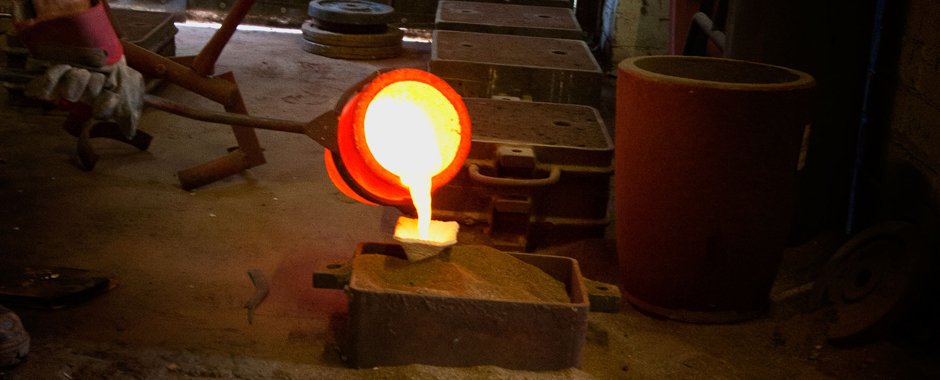
The Casting Process: Traditional Methods, Modern Control
Every piece followed the same rigorous workflow:
- Pattern Making: From architect’s drawings, Bronzecraft created wooden or resin patterns. For complex shapes, early digital scanning ensured exact alignment with stone openings—blending new technology with traditional craft
- Mould Preparation: Sand casting for larger parts; lost-wax for fine details, creating hollow ceramic moulds
- Melting & Pouring: High-grade bronze alloy (88% copper, 10% tin, 2% zinc) melted at 1,150°C, poured slowly to avoid porosity
- Fettling & Finishing: Trimmed, ground, and fitted to within 0.5mm tolerance
- Patination: Controlled chemical treatment to a medium-brown finish, chosen to mature naturally in Suffolk’s climate
- Quality Testing: Inspected for strength, finish, and dimensions before dispatch
On-Site Installation & Collaboration
Between March and June 2005, Bronzecraft’s team travelled from Attleborough to work alongside stonemasons, bricklayers, and bell hangers. The highest elements—including the finial and top grilles—were lifted using the main tower crane.
Key challenges included:
- Precision alignment: Bronze had to match stone within millimetres to prevent water ingress
- Thermal compatibility: Fixings allowed for slight expansion/contraction without loosening
- Visual harmony: All fastenings were hidden to preserve clean Gothic lines
Timothy Hannam later recalled: “Working on the Millennium Tower felt like joining a chain of craftsmen stretching back 800 years. We weren’t just fitting metal—we were making sure the tower would stand as long as the abbey ruins below it.”
Recognition: The Millennium Tower Medallion
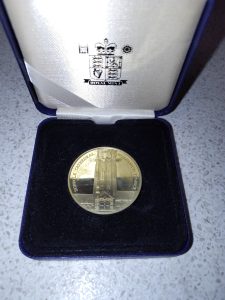
In appreciation of the exceptional quality and dedication shown throughout the project, Timothy Hannam, Director of Bronzecraft Ltd, was formally presented with the Millennium Tower Medallion by the Cathedral Custodians shortly after the opening .
This specially struck medallion was reserved for key individuals and contractors whose work was deemed essential to the tower’s successful completion. It bore the cathedral’s emblem, the completion date 2005, and the inscription: “For outstanding contribution to the building of the Millennium Tower”.
The award acknowledged not only the technical skill of Bronzecraft’s work but also the value of choosing local, specialist craftspeople. As the Custodians noted: “Timothy’s bronze work has set a benchmark for quality. It is fitting that his contribution is marked with this permanent memento.”
Unveiling & Legacy: 2005 to Today
Official Opening
On 22 July 2005, HRH The Prince of Wales unveiled the tower, calling it “a spiritual beacon for the new Millennium”. The ceremony included a service, bell peals, and celebrations attended by donors, locals, and craftspeople—including Timothy Hannam, receiving public recognition for his role.
The bronze work was immediately praised: “Exemplary—substantial, detailed, and perfectly integrated,” noted the cathedral’s conservation report. “It will not need replacement for 500 years or more.”
Long-Term Performance
More than two decades later, inspections in 2015 and 2020 found no structural degradation, only natural patina development. Maintenance records confirm: “Bronzecraft’s bronze has required almost no attention—proof that choosing quality local craft pays off long-term.”
Why This Matters: Heritage, Local Economy & Craft Continuity
Supporting East Anglian Heritage
By selecting Bronzecraft Ltd in Attleborough, the project demonstrated that:
- Small, specialist foundries deliver work of cathedral quality
- Traditional casting skills remain alive in Norfolk and Suffolk
- Local procurement strengthens regional craft economies and cuts carbon footprint
Setting a Benchmark
The success led to further commissions for Bronzecraft: bronze gates at Norwich Cathedral, medieval metalwork restoration at Wymondham Abbey, and sculptural work for Cambridge colleges. It also set a standard: prioritise durability, local skill, and heritage compatibility over lowest cost.
Conclusion
The Bury St Edmunds Millennium Tower (2005) stands as one of East Anglia’s defining heritage achievements. Its stone and brick form its shape, but its bronze elements—crafted by Bronzecraft Ltd of Attleborough—give it endurance, character, and connection to centuries-old metalworking tradition.
From tender to final patina, and culminating in the presentation of the Millennium Tower Medallion to director Timothy Hannam, this partnership proved how masterful, local craftsmanship can complete a project begun 1,000 years earlier. Today, when you look up at the tower’s cross, feel its bronze doors, or hear its bells, you see the work of a firm dedicated to keeping Britain’s heritage alive.