
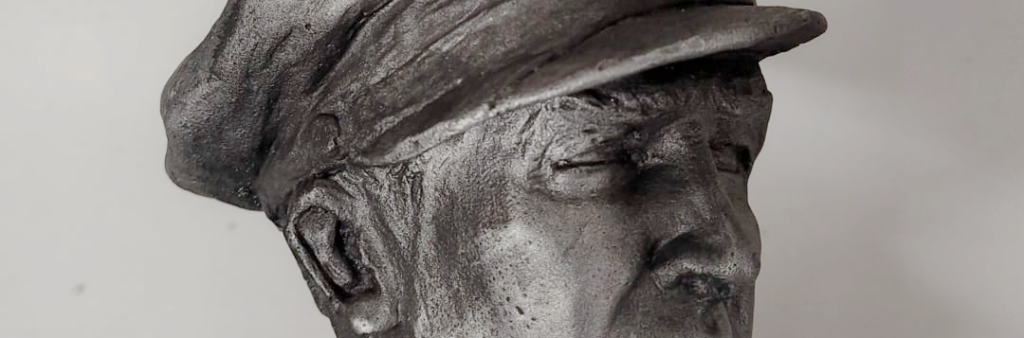

Standing on the former Second World‑War airfield at Old Buckenham, it is hard not to feel the weight of history. This is where we imagine the Hollywood star‑turned‑US‑Army‑Air‑Forces pilot Jimmy Stewart serving during the conflict, flying vital missions from these Norfolk fields. For a long time I had carried an idea: to create a sculpture honouring Stewart’s quiet courage and deep connection to this place. That was where the journey began not in a workshop, but walking the old run‑ways, imagining how best to capture his thoughtful, grounded presence for today’s visitors.
There is something deeply fitting about creating a memorial to Stewart within the very landscape where he once served.
 Knowing the project needed a sensitive artistic eye, I reached out first to Nina Mae Fowler, an international artist and an existing client whose work I long admired. I shared my vision: a compact, 600‑mm high study figure, capturing Stewart as he might have appeared on‑site at the airfield. Over several weeks Nina shaped the original form, refining posture and facial expression until she felt the piece truly resonated. Once satisfied with her finished model, she returned it to our foundry a special workplace housed within a repurposed Second‑World‑War-time building right here on the historic Old Buckenham site itself.
When we received Nina’s original sculpture, the mould-making phase began. We carefully painted layers of silicone rubber over the surface; this flexible material holds every fine detail of the original. Around that rubber layer we built a rigid backup jacket made of plaster. The silicone mould features shaped dovetail joints that lock securely inside the plaster case. Once the jacket was fully cured, we separated the mould halves and lifted away the original artwork, leaving an exact hollow impression ready for wax.
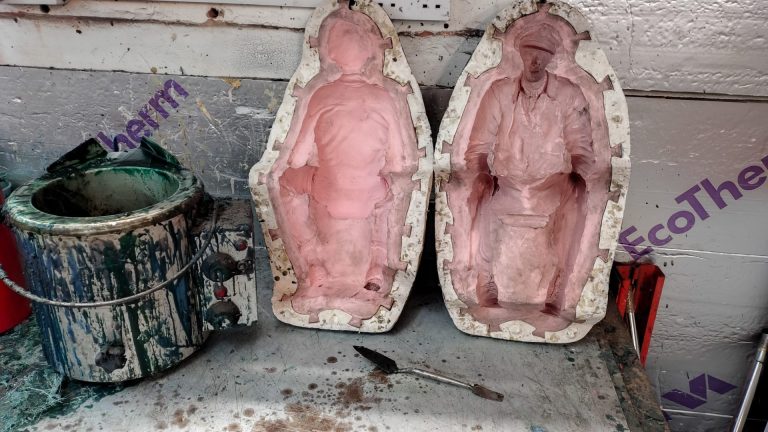
The first thin wax coat was brushed carefully into the mould interior before the two halves were clamped firmly shut. Hot liquid wax was poured inside to build up the main form. After cooling, the solid wax replica was taken out. Our wax‑chasing work then started: we carefully sanded, trimmed and blended away mould‑line seams and small surface imperfections, smoothing the figure back to its intended finish. Next we attached a runner‑and‑riser system: channels to guide molten metal into every part of the cavity, while allowing trapped air to escape safely to avoid voids in the finished casting.
Now ready for investment casting, the complete wax model and runner network were dipped repeatedly into a colloidal‑silica slurry, an air‑drying, non‑toxic ceramic‑shell mixture. We built up coats gradually, typically two each day across about a week, until the shell reached a sturdy wall‑thickness of roughly eight millimetres. The hardened ceramic shell then went into a dedicated dewax oven. Here the wax melted rapidly out from inside and was collected for recycling, leaving behind a precise hollow ceramic mould. While still hot, the shell was filled with molten aluminium. Once fully cooled, the brittle ceramic was broken away by hand and hammer, then the metal surface cleaned further using sand‑blasting.
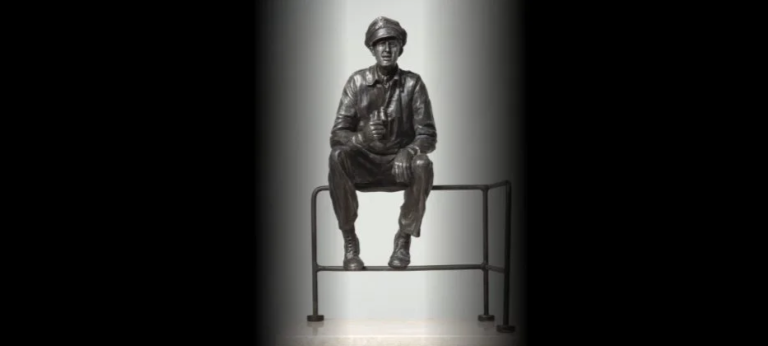
Back in solid metal, we cut away the runner‑and‑riser channels, re‑chased the surface for smoothness, and applied a dark black patina to give the aluminium sculpture depth and character. Finally a specialist sealing wax coat was brushed over everything to lock in the finish and protect it from weathering. We added a custom‑fabricated handrail detail referencing a surviving wartime photograph of Stewart on‑site, tying the small‑scale piece firmly back to its historical roots
This 600 mm aluminium study stands as our working proof‑of‑concept.
My longer‑term ambition is to create a life‑size public monument: Jimmy Stewart seated upon period‑style railings, to be cast this time in enduring bronze, installed somewhere accessible on or near the old airfield. Taking a small study to that scale is a separate challenge, which we cover in enlarging a bronze sculpture from maquette to monumental. It would offer visitors a quiet place to pause, to remember a famous man who chose military service far from home, and to celebrate the shared history of Old Buckenham. What began as a personal vision, passed between artist and foundry, could yet grow into something permanent for our community.
This 600 mm study is only part of the story. The sculpture’s origins in a wartime photograph, the aircraft aluminium it is made from and its connection to the film JIMMY, which opens in US cinemas on 6 November 2026, are covered in JIMMY (2026): Jimmy Stewart, Old Buckenham & Bronzecraft. If you would like to see Jimmy in person, viewing is by arrangement. And if you have a wax or model ready for bronze casting, get in touch.