Nina Mae Fowler at a glance
- Full name
- Nina Mae Fowler
- Also known as
- Nina Fowler
- Born
- 1981, London, England
- Nationality
- British
- Profession
- Contemporary artist, draughtsperson, sculptor and portrait artist
- Based in
- Norfolk, England
- Education
- BA Fine Art: Sculpture, University of Brighton, 2000–2003
- Best known for
- Large-scale pencil, graphite, black-chalk and charcoal drawings, often accompanied by sculpture or physically constructed frames
- Recurring subjects
- Golden Age Hollywood, fame, the female image, spectacle, spectatorship, desire, exploitation and private vulnerability
- Sculptural materials
- Bronze, cast brass, aluminium, steel, plaster, resin, slate, painted glass and found objects
- Public collections
- The National Portrait Gallery, London; Oxford University collections; Fondation Francès; Imago Mundi; Try-Me Collection; and others listed in the artist’s CV
- Spouse
- Painter Craig Wylie
Who is Nina Mae Fowler?
Nina Mae Fowler is a London-born British artist who turns images from cinema and celebrity culture into psychologically charged drawings, sculptures and installations. Fowler selects a public image. Fowler researches the person behind it. Fowler then remakes the image slowly by hand. That sequence—selection, research and transformation—moves the subject away from publicity and towards a more complicated account of power, performance and exposure.
Although Fowler is widely described as a draughtsperson, her formal training was in sculpture. She completed a Bachelor of Fine Art in Sculpture at the University of Brighton between 2000 and 2003. That education continues to shape the scale, weight, mounting and spatial presence of her work. A Fowler drawing may hang from metal eyelets, project from a wall, sit inside a hand-welded frame or face a sculpted counterpart. In her practice, a drawing is not always a flat image and a frame is not merely a border.
Fowler’s subjects include Marlene Dietrich, Judy Garland, Marilyn Monroe, Rudolph Valentino, Greta Garbo, Joan Crawford, Jean Harlow and Carole Landis. She does not simply reproduce famous faces. She often chooses a moment when a polished public identity falters: a star grieves, sleeps, runs, looks away, loses control or becomes absorbed in something beyond the camera. Fowler’s subject is therefore both the individual and the system that watches the individual.
Her work has been shown in London, Paris, Berlin, Leipzig, Maastricht and elsewhere. In 2019, the National Portrait Gallery commissioned her to draw nine British film directors. All nine portraits entered the Gallery’s permanent collection. Her official CV records her exhibitions, collections, awards and publications.
What defines Nina Mae Fowler’s artistic style?
Fowler’s art combines exacting observation with emotional ambiguity. Her drawings can appear photographic at first glance, but resemblance is a means rather than the final aim. Precision earns the viewer’s attention; changes of scale, cropping, material and presentation then change how the source image feels.
Six qualities recur across her drawings and sculptures:
- Cinematic framing. Fowler isolates a fraction of screen time and asks it to carry a new narrative outside the film.
- Archival depth. Film stills, documentary footage, publicity portraits, paparazzi photographs and biographical research inform the finished work.
- Monochrome drama. Graphite, pencil, black chalk and charcoal create deep blacks, abrupt highlights and the tonal atmosphere of early cinema.
- Physical presentation. Eyelets, metal, glass, aluminium, relief figures and sculpted frames give images bodily presence.
- Surface versus interior. Glamour attracts the viewer while grief, fear, compulsion, loneliness or exploitation complicates that attraction.
- The reversed gaze. Fowler depicts a person being watched, then makes the viewer conscious of watching.
Hollywood’s Golden Age supplies Fowler with a visual language of immaculate surfaces. The lives of its stars supply histories of labour, censorship, unequal power and public consumption. Fowler places those two truths together. Beauty remains beautiful, but beauty no longer remains innocent.
Why cinema matters
Fowler has described Brief Encounter as an early cinematic obsession. She has also explored silent film, film noir and the pre-Code films made before strict enforcement of Hollywood’s Production Code. Pre-Code cinema interests her because its characters could address adultery, alcohol, sexuality and social transgression with a directness that later censorship restricted.
A source film gives Fowler movement, lighting and performance. Archival research gives her context. The biography of an actor can alter the meaning of a fictional scene; a screen gesture can appear to echo the performer’s life. Fowler works in the tension between those two identities—the role and the person who played it.
Why vulnerability matters
Fowler repeatedly selects unguarded or transitional states. A sitter becomes absorbed. A star is caught between poses. A famous face shows strain. These moments resist the publicity image’s promise of total control. The work does not reduce its subjects to tragedy; it asks how audiences, cameras and institutions participate in turning human experience into spectacle.
How Nina Mae Fowler creates a drawing or sculpture
Fowler’s process begins with looking, but it is not a simple act of copying one photograph. Her method combines research, editing, drawing and construction.
1. Building an archive
Fowler gathers film stills, publicity images, historical paparazzi photographs, documentary material and frames captured from moving footage. She finds material online, in physical archives and through collecting. A subject may remain in her research for years before the right image and idea meet.
2. Finding the charged instant
When working from film, Fowler examines the seconds around a gesture or expression. She captures several frames and considers them together. The significant instant is often not the iconic one. It is the instant that remains emotionally active after its original plot has been removed.
3. Recomposing the source
Fowler selects, crops and sometimes combines elements rather than mechanically enlarging a single image. Composition changes the balance of power. Scale changes intimacy. A tight crop can withhold context; a monumental figure can overwhelm the spectator; a small ornament can turn a screen idol into a collectable object.
4. Drawing with dark and light
Her principal drawing materials include pencil, graphite, black chalk, compressed charcoal and coloured Conté. Charcoal offers deep blacks, clean erased lights and room for correction. The eraser becomes a drawing tool because it removes material to recover light. The medium also presents practical challenges: charcoal dust travels, unfixed marks remain fragile and accidental contact can change the surface.
5. Giving the image a body
The final presentation is part of the artwork. Fowler may attach eyelets, mount paper on aluminium, build a steel structure, paint glass, add a cast element or position a sculpture in front of a drawing. The support carries meaning. It can suggest restraint, ornament, display, violence, theatrical scenery or the physical machinery behind a flawless screen image.
Nina Mae Fowler’s sculptural practice
Fowler’s sculpture is not a secondary branch of her drawing practice. Sculpture changes how the viewer occupies the space around an image. It also tests the difference between the camera’s preferred view and the object’s complete form.
In I Wake Up Screaming, Fowler paired drawings of actor Carole Landis with small sculptural figures. The figures present a carefully resolved front—the angle that a cinema camera would show—but their rear surfaces remain visibly rough and unresolved. The polished view belongs to the screen; the incomplete reverse belongs to the object. As the viewer walks around the sculpture, Hollywood idealism gives way to raw material.
Fowler calls these small figures bozzetti, an Italian term for sculptural sketches. Their modest, ornament-like scale recalls Art Deco figurines and domestic souvenirs. Producing them as editions also introduces a deliberate parallel with the reproduction and merchandising of celebrity. The official I Wake Up Screaming project page documents the series and lists a 2022 gel-coated-resin sculpture as an edition of three plus one artist’s proof.
Drawings that behave like sculpture
Valentino’s Funeral covered roughly 15 metres with three enormous paper drawings. Conventional frames could not accommodate the installation, so Fowler suspended the sheets from metal eyelets like sails. The eyelet became a recurring device. It fixes vulnerable paper to a hard support and makes the tension of hanging visible.
Elsewhere, Fowler bends paper, mounts it on boards or aluminium, lets elements project beyond the picture plane and constructs frames from metal and glass. Her 2026 Celluloid Studio works combined pencil and graphite with hand-welded steel frames and painted glass. The frame directs the gaze, but it also declares itself as a fabricated object.
Sculpted and cast frames
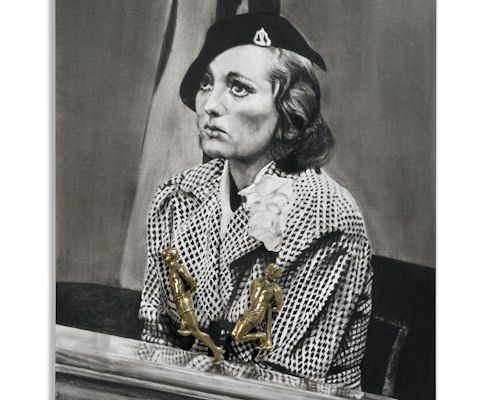
Fowler has surrounded drawings with bodies in relief. Blindfolded or entangled figures twist around an image as decoration, burden and narrative. In the Bull Fever works, cast-resin figures form tactile frames. In Knockers, unique cast-brass figures attach directly to monumental black-chalk drawings. In each case, sculpture interrupts the apparent depth of the drawn image with a real object occupying the viewer’s space.
Materials, editions and casting choices
Fowler does not work in one sculptural material or follow a single casting formula. She selects materials in relation to the idea, scale and role of the object. Metal can make an ornament feel weighty. Plaster can retain immediacy. Resin can repeat a form. Steel can function as structure. A found household object can carry memory before the artist adds anything to it.
| Material or process |
Representative work |
What the material contributes |
| Bronze, steel and slate |
A Real Allegory: Part I, Male (2011) |
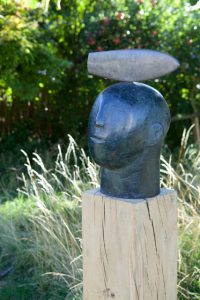
Cast figure, structural support and a dark mineral base combine in one three-dimensional work. |
| Cast brass |
Knockers (2013) |
Ornamental shine and physical weight turn bound male bodies into unique door-knocker forms. |
| Aluminium |
Jimmy (2014) and painted-aluminium bozzetti |
A cast or finished metal form brings screen-derived figures into durable physical space. |
| Plaster, bronze and found objects |
Love Mass (2019–2022) |
Body fragments meet antique jelly moulds and other domestic objects, connecting touch, family and memory. |
| Gel-coated or painted resin |
I Wake Up Screaming and Bull Fever |
Resin permits repeated sculptural forms and integrated relief structures. |
| Hand-welded steel and painted glass |
Celluloid Studio (2026) |
The fabricated frame becomes part of the image’s cinematic staging. |
Casting preferences
Fowler casts in bronze, brass and aluminium and has produced editioned sculpture in resin. Her sculpture often preserves a distinction between a highly resolved, camera-facing surface and a rougher reverse, and her cast elements operate as ornament, frame, replica or counterpart to a drawing.
Bronzecraft casts in both lost-wax and sand, and the route is chosen to suit each sculpture. Alloys, patinas and edition sizes are decided work by work and recorded on the individual sculpture’s documentation.
How form and concept guide the material
Material follows meaning in Fowler’s work. Brass suits the Victorian door furniture referenced by Knockers. Aluminium suits the sculptural translation and wartime material history of Jimmy. Plaster and antique kitchenware give Love Mass domestic intimacy. Resin supports repetition in I Wake Up Screaming. Steel and glass turn later frames into architectural viewing devices. The common preference is not one metal; it is a close relationship between material, image and idea.
Nina Mae Fowler, Timothy Hannam and Bronzecraft
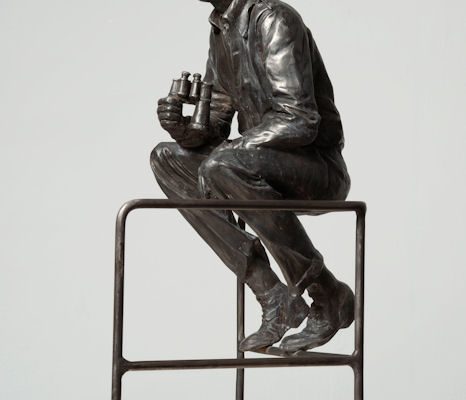
Fowler has a working relationship with Bronzecraft, collaborating on Jimmy, created with Bronzecraft’s Timothy Hannam in 2014.
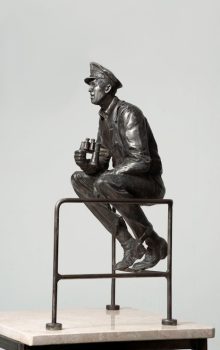 Jimmy recreates a photograph of American actor James Stewart taken at Old Buckenham airfield in Norfolk in 1944, when Stewart was serving with the 453rd Bomb Group. The sculpture is aluminium, and some of the aluminium came from a Second World War aircraft. Fowler supplied the artistic concept and image-led sculptural language; Hannam and Bronzecraft supplied specialist foundry knowledge. Together, the collaborators translated an archival wartime photograph into a physical object.
Fowler’s sculpture brings together cinema, wartime history and Norfolk’s local heritage. Based on a 1944 photograph of Hollywood actor and airman James Stewart at Old Buckenham, the work transforms an archival image into a physical sculpture. Its use of aluminium recalls the material history of aircraft, while Fowler’s collaboration with Bronzecraft translates her image-led research into cast metal.
Major works and series
Valentino’s Funeral
This early installation examines the public frenzy surrounding the death of silent-film star Rudolph Valentino. Three monumental paper drawings extended across approximately 15 metres. Fowler used exposed eyelets to suspend them, making display, fragility and physical tension visible. The work established a continuing relationship between drawing and installation.
A Real Allegory
A Real Allegory brought Fowler’s two- and three-dimensional practices into direct dialogue. The 2011 work A Real Allegory: Part I, Male uses bronze, steel and slate. The series helped develop a method in which a sculpture and drawing can describe the same subject from different material positions.
Knockers
Created for Starke Frauen at Neuer Kunstverein Aschaffenburg, Knockers pairs monumental drawings of women including Joan Crawford, Marilyn Monroe, Jean Harlow and Marlene Dietrich with cast-brass male figures attached like door knockers. The small men are bound and struggling; the women appear commanding yet are also burdened and sexualised by the ornaments fixed to their bodies.
Each brass pair is unique rather than moulded as a repeated edition. The figures draw on images of US Navy SEAL survival training and on the twisting bodies of Michelangelo’s slave sculptures. The result complicates any simple reading of strength and submission. The official essay on Knockers explains the work’s relationship to objectification, dominance and vulnerability.
Measuring Elvis
Measuring Elvis became a major body of work and the title of Fowler’s 2015 monograph, published by Cob Gallery. The project consolidated her examination of celebrity, reproduction and the distance between a public icon and a private human life.
While I’m Still Warm
Shown at Cob Gallery in London in 2017, While I’m Still Warm combined Hollywood’s visual richness with an examination of the celebrity machine’s grotesque workings. Drawings, installations and sculpted frames made glamour and damage inseparable.
Luminary Drawings
In 2019, the National Portrait Gallery commissioned Fowler to create portraits of nine British film directors: Amma Asante, Paul Greengrass, Asif Kapadia, Ken Loach, Sam Mendes, Nick Park, Sally Potter, Sir Ridley Scott and Joe Wright. Fowler drew each director while they watched a film of personal importance. The chosen films remain private between artist and sitter.
Each title uses a timecode. Each timecode identifies a moment in the viewing session. Each portrait therefore records a director as a spectator rather than as the person controlling the screen. The complete group entered the National Portrait Gallery’s permanent collection. The Gallery’s Luminary Drawings record documents the commission.
Ruined Finery
The 2020 works combine charcoal with screen-printed paper and vinyl. Subjects include Greta Garbo, Lana Turner and Libby Holman—women whose public identities became entangled with performance, scandal and media mythology. Cob Gallery published an accompanying volume covering Fowler’s drawing and sculpture from 2015 to 2020.
Love Mass
Made between 2019 and 2022, Love Mass draws on Marlene Dietrich’s relationship with her grandson Michael Riva. Plaster figures meet antique jelly moulds, typewriter parts and other found objects. In PS, I love you, plaster, bronze and an antique jelly mould bring bodily gesture and domestic memory together. The official sculpture record lists the materials and dimensions of the series.
Snails and Oysters
Cob Gallery presented this suite of four drawings in 2024. The exhibition uses hunger and appetite to continue Fowler’s exploration of desire, consumption and bodily vulnerability.
Sleeping Beauties
Hotel Beaumont in Maastricht commissioned 16 drawings for its rooms. Fowler selected sleeping women from cinema, including screen images associated with Marlene Dietrich, Bette Davis, Marilyn Monroe and Dorothy Dandridge. She named each drawing after a woman from the Beaumont family. The project connects women seen sleeping on screen with women whose less visible labour sustained a family hotel.
Celluloid Studio
Shown at Galerie Suzanne Tarasieve in Paris in 2026, Celluloid Studio combined pencil and graphite drawings with hand-welded steel frames and painted glass. Some works were mounted on aluminium. The series demonstrates that Fowler’s sculptural training still governs how a drawn image meets a wall, a frame and a viewer.
Portrait commissions and the unguarded sitter
Fowler’s portraiture applies the same principle she uses with cinema: an absorbed person often reveals more than a formally posed one. For Luminary Drawings, watching a film gave each director a meaningful task. The sitter looked at a screen. Fowler looked at the sitter. The resulting portrait records concentration, memory and response.
Her institutional commissions include portraits of evolutionary biologist Richard Dawkins, biographer Dame Hermione Lee and writer Dambudzo Marechera for Oxford colleges, as well as a portrait of former South Hampstead High School headmistress Jenny Stephen. Her 2008 portrait of Royal Ballet dancer Carlos Acosta was selected for the BP Portrait Award exhibition. Fowler did not win that award; her husband, painter Craig Wylie, won the 2008 BP Portrait Award.
Movement and absorption connect these portraits with her other work. Fowler is drawn to bodies doing something: watching, dancing, running, sleeping, grieving or turning away. Gesture becomes evidence. The face remains important, but posture and situation complete the psychological account.
Early life, family and artistic influences
Fowler grew up in London and attended South Hampstead High School, graduating in 1999. London gave her access to museums and galleries; she has described the National Portrait Gallery as a formative favourite. Norfolk was also present early in her life through childhood weekends in the county. She later made Norfolk her home and studio base.
Her family encouraged making. Fowler has described her father as an architect who advised her about constructing objects, her mother as a clothing designer whose taste influenced her and her brother as a source of musical discovery. At 16, her father took her to Hollywood via Elvis Presley’s Graceland. The journey joined an existing fascination with cinema to the real geography and mythology of celebrity.
After university, Fowler worked as an archivist or assistant to John Dunbar, co-founder of London’s Indica Gallery. That experience anticipated her mature method. The archivist gathers and classifies evidence; Fowler gathers and reinterprets visual evidence. Through Dunbar, she also encountered Soho’s Colony Room circle and the clubs and bars around Dean Street.
Fowler’s visual references include Édouard Manet, Michelangelo, Auguste Rodin, Pablo Picasso, Marcel Duchamp and Arshile Gorky. Manet demonstrated how restrained means could provoke a powerful social response. Michelangelo and Rodin inform the fragmented bodies of her sculptural figures. Duchamp’s Étant donnés offers a model of controlled viewing and concealed construction.
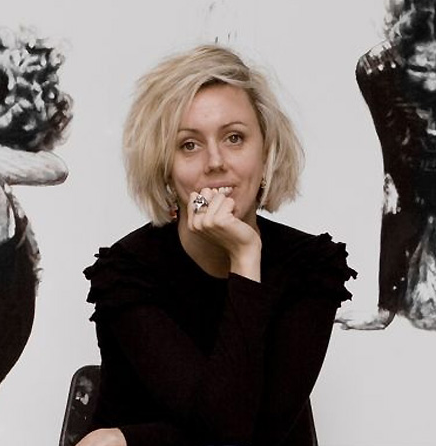
Fowler is married to painter Craig Wylie. The couple live and work in Norfolk and have two children. Their family life is organised around adjacent creative and domestic spaces. Wylie and Fowler offer each other artistic criticism, but their visual languages remain distinct: Wylie is associated with painting and colour, while Fowler’s best-known work grows from monochrome drawing, cinema and sculptural display.
Education, exhibitions, collections and publications
- 2000–2003: Fowler studied Fine Art Sculpture at the University of Brighton.
- 2008: Her portrait of Carlos Acosta appeared in the BP Portrait Award exhibition.
- 2009: Valentino’s Funeral established her large-scale drawing-installation language.
- 2010 and 2015: She was shortlisted for the Jerwood Drawing Prize.
- 2013: Knockers brought black-chalk drawing and unique cast-brass sculpture together.
- 2014: Fowler and Timothy Hannam of Bronzecraft collaborated on Jimmy.
- 2015: Cob Gallery published Nina Mae Fowler: Measuring Elvis.
- 2018: David Lynch’s Silencio in Paris presented a retrospective of her work.
- 2019: The National Portrait Gallery unveiled the nine Luminary Drawings.
- 2020: Cob Gallery published Ruined Finery.
- 2024: Cob Gallery presented Snails and Oysters.
- 2025: Sleeping Beauties was presented at Hotel Beaumont in Maastricht with an accompanying publication.
- 2026: Galerie Suzanne Tarasieve presented Celluloid Studio in Paris.
Fowler’s work belongs to the permanent collection of the National Portrait Gallery and to Oxford University collections. Her official CV also lists Fondation Francès, Imago Mundi, the Try-Me Collection and Colección Al Límite among public collections. Private collectors include Sir Ridley Scott, Jude Law, Caroline Issa and Sharleen Spiteri.
Her major dedicated publications are Measuring Elvis (2015), Ruined Finery (2020) and Sleeping Beauties (2025). Together, the books document the continuity between drawing, sculpture, cinematic research and the politics of looking.
How to look at a Nina Mae Fowler sculpture
Start with the viewpoint the work appears to favour. Does the sculpture reproduce a camera angle? Does its front appear more resolved than its reverse? Walk around it if the display permits. Fowler often places meaning in the difference between the image offered to the viewer and the material structure that supports it.
Next, compare the sculpture with any accompanying drawing. Identify what remains consistent: pose, contour, gesture or crop. Then identify what changes: scale, texture, incompleteness, weight or colour. The shift between two dimensions and three dimensions is part of the subject.
Look closely at attachments and frames. An eyelet can make paper feel tethered. A cast-brass figure can behave as ornament and burden. A steel frame can resemble a viewing apparatus. Painted glass can filter an image. Ask what the support makes you do physically: stand in front, peer through, move sideways or become aware of your own gaze.
For a cast work, consult its object label or documentation. Confirm the metal, edition number, foundry, date and finish rather than inferring them from appearance. Fowler has worked across bronze, brass, aluminium and resin, so colour alone is not a reliable guide to material or process.